Management Systems Oriented to the Best Organisational Performance
Management Systems Oriented to the Best Organisational Performance

10/07/2025
Management & Leadership
Every organisation is focused on performance. However, that doesn’t mean that all employees will achieve their best organisational performance, which includes competitiveness, customer satisfaction, and controlled costs.
The definition of the best performance for an organisation is closely linked to its strategy. A low-cost airline or a low-price supermarket will translate great organisational performance into having competitive prices, whereas a luxury goods company will determine its organisational performance based on product or service quality. A government entity will focus on efficiency and civilian service.
As a result, there is no one definition of “best organisational performance”. It will depend on the organisation's strategy. But there is only one way to reach the best performance. And the main issue is the management methodology, which refers to the ability to optimize organisational performance through planned development and strategic alignment.
Why Most Organisations Fall Short of Their Goals
The reality is that, apart from “world-class organisations”, very few businesses, start-ups, and individuals are aware of the necessary steps that will lead an organisation to achieve its best.
So, having defined the organisation's strategy, vision, and strategic goals, the first step is to establish how to measure those goals. And how to measure the “functional” goals that will lead the organisation to achieve the strategic results.
A good way to start is developing a strategic map, establishing those relationships, and defining the key performance indicators (KPIs) for each of the goals.
FIGURE 1 – Real Example of a Strategic Map
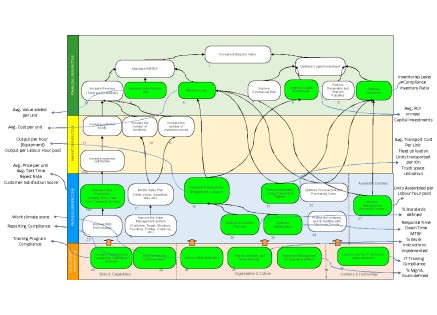
Hundreds of indicators and measures might answer the question "Is this good?", but only a few were designed to monitor the progress of strategic objectives across departments and teams and thus can be qualified as Key Performance Indicators.
In a manufacturing environment, a production manager measures output. In a service organisation, a customer service manager measures customer satisfaction. In a sales environment, the turnover is measured by procurement vs sales measurements. etc. More than three or four KPIs per function is confusing and doesn’t set priorities anymore.
Setting SMART Goals to Drive Improvement
The next logical step is to define the goals that must be achieved for each KPI. This is the first phase of any performance-oriented management system.
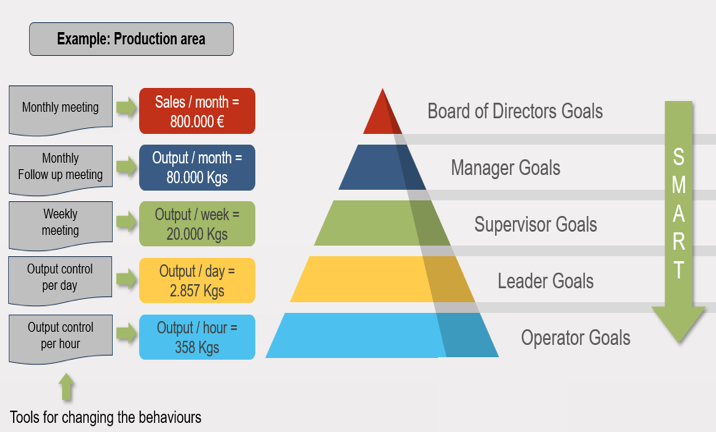
For effectively improving organisational performance, goals need to be SMART (Specific, Measurable, Achievable, Relevant and Timely), and this is the standard that the organisation or the functional area will use to compare the actual performance.
FIGURE 2 – Smart Goals
Once the goals are defined, the second phase of a management system oriented to performance is to plan how to achieve those goals.
Planning, in the context of management, refers to establishing the resources and activities necessary to achieve a goal. Depending on the nature of the area, resources could include factors such as people time, equipment time, visits to potential customers, raw material, phone calls, emails, etc.
In any case, it is essential to measure the amount of resources that achieve the desired productivity. And even when this is very logical, most organisations fail to understand the amount and dimensions of resources and experience required.
Case Studies: Where Things Go Wrong
In my professional life, I have seen multiple examples. I will describe a few of them:
- A Utility company had not measured the customer attendance rate at each of its customer service centres, didn’t know the average time to resolve any incident, and therefore was unable to define the correct number of customer service agents typically required to service customers properly.
- A manufacturing company that didn’t know the labour time its workforce required to complete all the steps of the manufacturing and assembly process, which resulted in bottlenecks, excessive crewing, waiting times, and poor output.
- A labour union that provided legal advice to its members didn’t have the means to measure the average call duration and waiting time across their call centre. Hence, they never had the right crew in place, and they didn’t know the average consulting time per session. As a result, they were never able to plan the right number of advisors in their various branches.
- A Hospital that didn’t know the average time it took to produce a radiographical image, resulting in prolonged waiting times and an inability to determine when to activate the additional imaging units.
- A sales department that didn’t know how many contacts were necessary to set a visit and how many visits were necessary to sign a contract never achieved its sales goals.
- A bank that had no measurement for the average time of each of the steps of the loan process, which became less competitive because of its long cycle time for approvals.
Each of these cases is discussing the critical impact of operational inefficiencies on organisational performance, success, and the effectiveness of employees. Understanding the level of activity and resources required to achieve a goal is basic to the planning phase.
Nevertheless, things don’t happen in the blink of an eye. World-class organisations avoid falling into these traps by investing in Management training courses in London to train their leaders to spot and evade all of these common pitfalls.
Monitoring and Controlling Organisational Performance
Once the planning is complete, the execution of the work required to achieve the goal should begin. At a management level, this is defined as assigning different tasks to various resources. This includes proper verbal or written instructions (procedures, job descriptions, task instructions, safety measurements, etc.)
The final chapter of achieving excellence in organisational performance is to ensure that the planned activities have been executed.
This control is effective when done with the frequency required to allow for taking corrective action if the result is not the one planned, and should be focused not only on the result but also on the activities developed to achieve the goal.
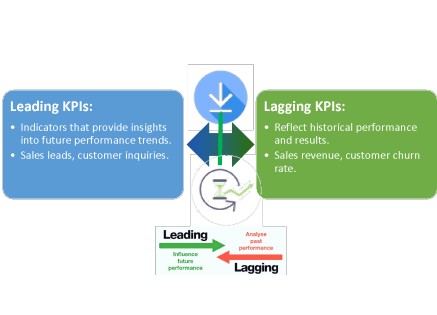
Going back to the Key Performance Indicators, in this phase of control is useful to differentiate the two categories: Lagging and Leading Indicators.
Lagging Indicators tell what has happened. They tell the result.
Leading Indicators tell what would happen. They allow us to predict the outcome.
For example, in a sales area, usually, everything is focused on the outcome, the turnover.
That is a lagging indicator. It tells how much the sales department has sold during the last month. Of course, this indicator is very important and is usually the main Key Performance Indicator for a sales area.
But is the level of sales activity that will influence the outcome, the turnover? If the sales team remains inactive, the turnover will drop. So, to measure the sales activity (customer contacts, visits, offers presented, etc.) every week will increase the possibility of achieving the outcome. These are leading indicators that will influence the achievement of the goal in the future.
FIGURE 3 – Lagging and Leading Indicators
losing the Performance Loop
A proper control phase is essential for organisational performance success. It involves the comparison of the plan with the actual performance and identifying the variances between them.
This evaluation process also involves measuring individual contributions and team output using tools such as rating scales and feedback forms.
A variance analysis needs to be done to understand the causes (Root Cause Analysis), and a corrective action should be defined and implemented in order to, at the end of the period, achieve the goal.
The purpose of such analysis is to improve processes, develop leadership practices, and transform workplace behaviour for long-term growth, while enhancing employee motivation and focusing on the learning process.
This management cycle (Goal Setting – Planning – Execution – Control – Variance – Corrective Action) is the basis for success and the proven methodology to achieve the strategic and functional goals in an organisation.
FIGURE 4 – The Management Cycle
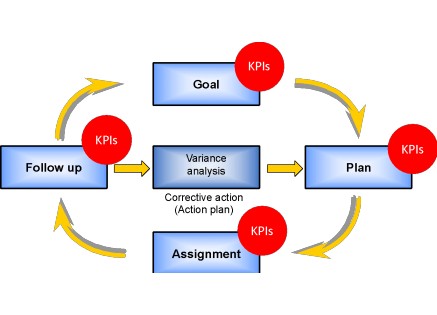
The reality in the business environment and government, and non-profit organisations is that very few organisations embrace it, so performance suffers and strategies fail.
A few final words
Organisational performance allows business leaders to study different perspectives of a company’s performance. Be it human behavior, technology, what is done right, or which tool could bring it more revenue.
Great performance doesn't happen by chance; it’s designed, measured, and refined. If your organisation is still operating without a clear management system or struggling to turn strategy into execution, it’s time to act.
Mariano de Bernardi
Mariano de Bernardi is a management consultant, trainer and executive coach with more than 30 years of experience helping organisations in Europe, Asia and the Americas to become more efficient, effective and competitive.
He has been Partner in global consulting companies and had worked with more than a hundred private companies from World Class, like Siemens, Nestlé, Air France, Novartis, Philips, Schlumberger, Unilever, etc., to family companies and start-ups.
He had also worked with Government services (Healthcare, Public Transport, Start-ups Support) and Non-Profit Organisations (Labour Unions, Universities, International Agencies) to help them improve their service and their productivity.
Mariano holds a Bachelor degree in Law and Political Sciences, a Master degree in Economics and Business Administration and is an ICF Certified Executive Coach .
His training expertise extends to several areas of management (Strategy, Operations, Logistics, Sales, Supply Chain, Procurement, Contract Management, Customer Service, Project Management) and leadership (Emotional Intelligence, Time Management, Critical Thinking, Problem Solving, Decision Making, Effective Communication, Influence, Negotiation, Change Management, Conflict Resolution, Staff development, etc.
He is also an inspirational public speaker frequently invited to Business Summits and Congresses.
Related Articles

The efficiency of administrative communication in 2021
The efficiency of administrative communication in 2021
Read More
Restoring tourism activity in Dubai between reality and challenges
Restoring tourism activity in Dubai between reality and challenges
Read More
Which leadership skills make you a great leader?
Which leadership skills make you a great leader?
Read More